

Aggregate Events
An aggregate event associates identified items or item instances with a logistics unit, such as a pallet or shipping container. It records which…
Start with Understanding Event-Based Traceability in Wholechain for shared concepts. To perform this event in the application, see Aggregate.
What an aggregate event represents
An aggregate event associates identified items or item instances with a logistics unit, such as a pallet or shipping container. It records which contents belong to that unit.
The logistics unit has its own identifier. Wholechain accepts two kinds, and you pick one for each container:
- SSCC (Serial Shipping Container Code), a GS1 identifier for pallets, cartons, and other logistics units.
- A general Logistic ID, a free-text string you define.
When and why to use it
Use aggregate when you've grouped identified items for storage or transport and want to handle the group as one thing. It most often happens before shipping.
While items are aggregated, you can ship the container rather than repeatedly selecting every contained item and lot. That saves effort and reduces mistakes when a pallet holds many items.
What it does to traceability history
Aggregation adds a "these items are together in this unit" step. The contents stay the same. Aggregation does not physically transform the contents into a new product. Each item keeps its own identifier and properties, so you can still trace any individual lot inside a pallet.
A later disaggregate event ends the association.
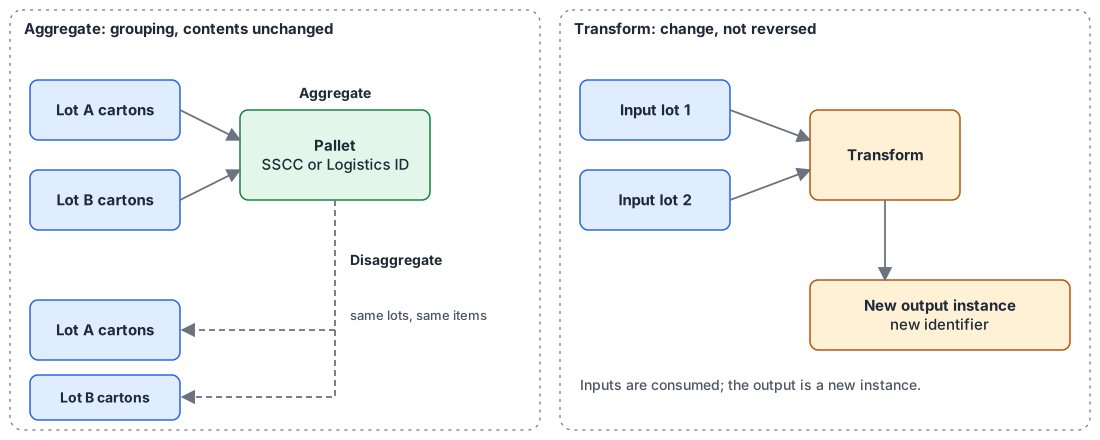
Aggregation compared with transformation.
Required information and master-data prerequisites
| Category | For aggregate |
|---|---|
| Location | Where the items were grouped. |
| Item | The items going into the unit. |
| Quantity | How much of each is in the unit, in each item's configured unit of measure. |
| Lot or serial identifier | The instances being grouped. |
| Event date and time | When the grouping occurred. |
| Container identifier | The logistics unit's identifier: an SSCC or a general Logistic ID. |
Set up the items (Trade Items) and your Location (Locations) first.
Relationship to inventory, lots or serials, and other events
- Inventory. The grouped items remain your inventory, now associated with the unit. You can aggregate part of a lot, which effectively portions it out before shipment. The rest of the lot stays available.
- Lots or serials. Each content lot keeps its identifier. The unit has its own.
- Mixed contents. One container can hold different items and different lots.
- Across Trade Partners. When you ship a container, the aggregation carries across to the receiver. The receiver must disaggregate before acting on the contents with events other than a subsequent ship or observe.
- Other events. Aggregation commonly comes before ship. The destination receives the unit and later disaggregates it. Aggregating is different from transform.
Example
Northline Processing packs cartons from fillet lots FIL-0412-A (30 cartons) and FIL-0413-B (20 cartons) onto one pallet identified by an SSCC. Only part of each lot goes on this pallet. The rest stays available for other uses. It records one aggregate event at its Cold Store. It then ships the pallet to Metro Fresh as one unit, without selecting each lot again.
A business that ships loose cartons, or that doesn't use pallets for traceability, doesn't need aggregate events.
Common misunderstandings
- "Aggregating makes a new product." It doesn't. If the contents change, use transform.
- "The pallet replaces the lot." The pallet is a container. Lots inside remain individually identified.
- "Any code works as a pallet ID." Use an SSCC or a general Logistic ID, one for each container.
- "Aggregation is mandatory before shipping." It isn't. Use it when it matches how you handle goods.
- "I can put a pallet inside a larger container." Nested containers aren't supported at this time.
- "I can reuse a pallet ID." Container identifiers can't be reused.
Relevant restrictions
- Aggregation happens at your own Location. If a Trade Partner is Wholechain connected, your account can't aggregate at that partner's Locations. See connected trade partners.
- Nested containers aren't supported at this time.
- A container identifier can't be reused.
Notes on standards and regulations
- GDST (Global Dialogue on Seafood Traceability): See GDST and Wholechain for what GDST expects about logistics units.
- FSMA 204 (the U.S. FDA Food Traceability Rule): See FSMA 204 and Wholechain for how pallet-level records relate to the rule's lot-level records.
Aggregation doesn't by itself establish compliance with a standard or regulation.
Related documentation
- To perform this event, see Aggregate. For all event types, see the Wholechain Events Overview.
- Understanding Event-Based Traceability in Wholechain
- Ship Events · Receive Events · Disaggregate Events · Transform Events
- Event-Based Traceability FAQ
- Trade Items · Locations
- GDST and Wholechain · FSMA 204 and Wholechain